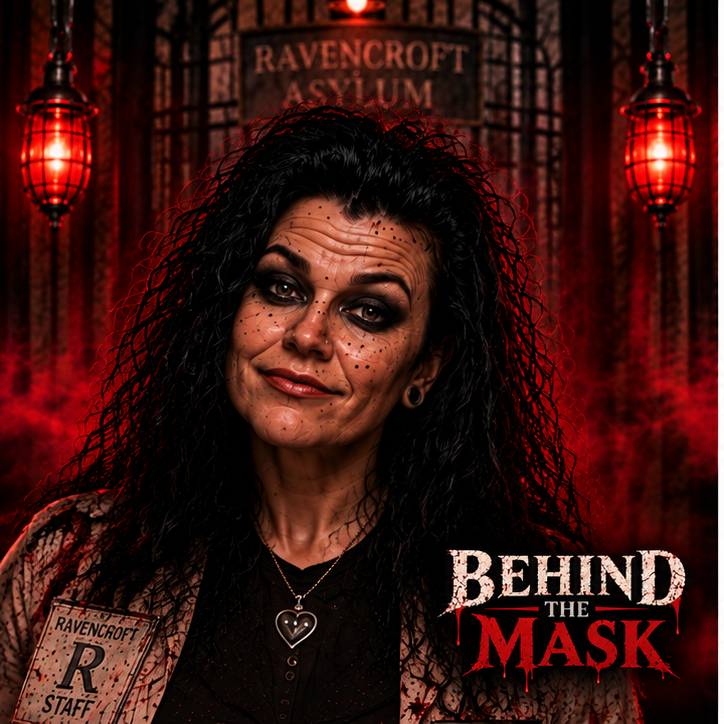
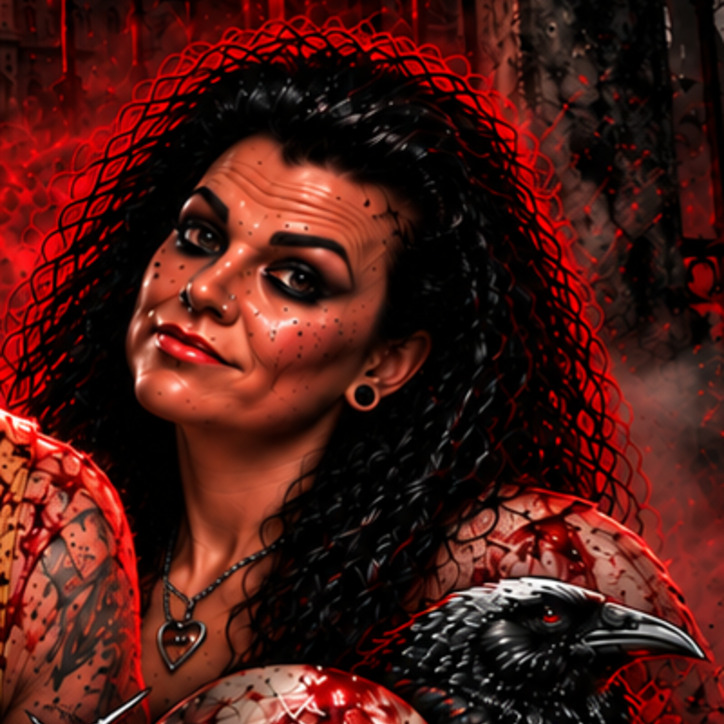
Psycho brings the creative drive and the personal questions that give Behind the Mask its heart. She wants to know how a character came to life, but she also wants to meet the person who keeps putting the costume on.
The interview
Getting past the introduction
A name, a haunt, and a costume are the starting point. Psycho’s curiosity reaches into the choices behind them: why someone started, what made them stay, how their confidence changed, and which moments still mean something after the season ends. Her background in human services and geriatrics informs that interest in people’s experiences. There is room for pride, frustration, an unexpected laugh, and an answer that takes a little longer to find.
The atmosphere
A sharp wit with room for honesty
Her sarcasm gives a conversation energy. She can tease, react, and let a funny story be funny without losing interest in what the guest is actually saying. When a conversation turns personal, the aim is to make room for the person telling it. That combination gives the show a voice that can enjoy the monsters and still care about the people wearing them.
Behind the scenes
Giving the show a world of its own
As co-creator and co-founder, Psycho brings creative direction and production to the partnership. The interviews, character storytelling, and Ravencroft world all need a recognizable voice. She helps connect those pieces, giving listeners more ways to enter Behind the Mask while keeping the people in each interview at the center. The character adds atmosphere; the guest’s story gives the conversation its reason to exist.
Together at the microphone
Schizo brings a story into the room; Psycho is ready to pull on the detail that makes it interesting. She can match his teasing and bring the conversation back to the guest. Their back-and-forth gives an episode its personality, while their shared curiosity keeps it moving toward the same question: who are we meeting behind this mask?
The backstory below follows Psycho’s fictional character in the Ravencroft world by J.M. Hale.
Fiery
The comeback usually arrives before the filter does.
Protective
She notices who has been left out—and makes room.
Guarded
A joke is easier than admitting something hurts.
01
Before the mask
She used to have the keys.
Before Ravencroft gave her a number, Psycho knew the building as a place of work. She started as an activity assistant while she was in college, then worked her way up to Head of Geriatrics. For four years, she was the person organizing the day, learning the residents’ routines, and finding ways to reach people everyone else had stopped trying to understand.
The mouth was already there. So was the attitude. But underneath both was a woman who cared about the little things: a familiar face, a family photograph, the difference between someone being difficult and someone needing to be heard. She could be loud enough to fill a hallway and still notice the quietest person in it.
02
The turning point
Then she came back through the doors.
The life she had built began coming apart. She lost her job. Her family life fractured. Grief followed her into the spaces where work and routine used to be. The woman who knew how to keep everybody else moving could no longer keep herself together.
Her breaking point came at her mother’s grave. An emergency-room visit led her back to Ravencroft, this time as a patient. The doors were familiar. Being on the other side of them was not. The former Head of Geriatrics became Subject 001.
03
Under her skin
She will argue. She will also stay.
Psycho is sarcastic, stubborn, and very capable of making her opinion everybody’s business. If she is scared, you may hear anger first. If she is hurting, you may get a joke sharp enough to change the subject. Being vulnerable means giving someone the chance to leave, and she has already lost enough.
But care is still her first language, even when she disguises it as complaining. She remembers what matters to people. She defends them. She keeps showing up. The softer side is there in the way she treats Manic, in the things she cannot quite say, and in the rare moments when she stops trying to carry everything alone.
04
Psycho & Schizo
The teasing was the beginning.
She met Schizo through his cousin while she was working at Ravencroft and he was already a patient. They talked. They argued. They made each other laugh. The names Psycho and Schizo began as teasing between two people who were learning exactly how to get under each other’s skin.
He can answer back. He can be ridiculous. He can see when her anger is covering something else. With him, she does not have to be the woman who has every answer. Their affection lives in the banter, the apologies, and the decision to come back to one another after an argument.
05
Beyond Ravencroft
She wants a life of her own.
Leaving Ravencroft does not magically make her past disappear. It gives her a chance to build something beyond the place that assigned her a number. Schizo leaves with her; Manic follows. Their story carries the friendships, grief, and unfinished business out through the doors with them.
For Psycho, freedom is personal. It is choosing who gets to know her, who she stands beside, and what comes next. The attitude comes with her. So does the heart she keeps insisting is none of anybody’s business.
The story continues
Every mask has a person behind it.
Step further into Ravencroft in The Doors Were Open, or meet the other half of Behind the Mask.